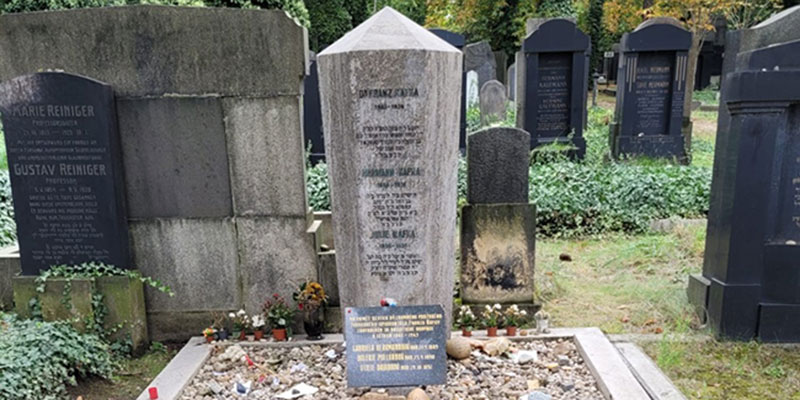
On a recent trip to Prague, I had the fortunate experience of visiting the Frans Kafka museum and I followed this up with a visit to his gravesite. Considering that this marks one hundred years since his death at the age of forty.
It felt quite serendipitous that on my return I received a notification that the International Leadership Association would be hosting a webinar presented by Dr Leah Tomkins on her latest book, Frans Kafka, The Truth of Leadership.
In this fascinating interview, Tomkins reveals parts of her book on The Truth of Leadership, focussed on Frans Kafka that I found this hugely beneficial in my work around leadership and leadership development.
These are my takes from this interview by Dr. Leah Tomkins on Kafka. She shared the following, which I found revealing, interesting, and insightful. She unmasks the preconceived ideas of Kafka, especially around leadership. Kafka is often seen as the patron saint of the victim, this little guy fighting the system; however, far more is revealed of this formidable man.
The interview shares that Kafka was a leading strategist and policymaker in the insurance industry of his time. He was the spokesperson of the sector, the equivalent as described by Tomkins, in today’s speak, a keynote speaker in the field of accident insurance. Kafka she shares writes from the perspective of wielding power and not yielding to power. The lesson drawn from this as described further by Tomkins is that power is exercised and not possessed.
Tomkins goes on to share that Leaders often exercise a degree of poetic licence regarding truths and Kafka describes why we are prone to follow one version of events over another. In a post-truth world, leaders are prepared to challenge what is a fact. This was intriguing and one cannot help thinking of current world leaders and captains of industry. What I found disturbing is that in a post-truth world, it is not who has the facts, but the one who can come up with the best version to persuade. Kafka draws our attention to this, and Tomkins alerts us to this. The facts do not drive, rather it is often a competing version of the facts. The Kafka truth strategy.
The discussion goes further to discuss strategic ambiguity, Truth versus non truth described in such a manner for us to believe that it is true. Today leaders often create a space for followers to project their wants and needs onto the leader. A manipulation of attention – playing with attention and distraction. When the attention of your audience is directed to one place, they are distracted for you to do something else.
Dr. Tomkins then goes further in her interview to share that in her work around Kafka, when an organization malfunctions, there is always something that we can do about it. In her words, “Don’t blind yourself to your complicity.” We need to speak the truth to the power that we have within us. We have the power to accept or refuse the narrative that is fed to us. Tomkins describes our freedom as being within the relationship of power, truth, and language. We can determine how we allow ourselves to be led. We should not assume that we are guilty, just because we feel guilty, an ability that many leaders often make us feel and experience. We need to be aware of the dynamics of power and truth.
The statement in closing by Tomkins is that we can observe the tactics of leaders and not be seduced to believe one version of events (power, truth, and language). In conclusion, I am now more adamant to read and discover more about Kafka and look at his work through a completely different lens. I also look forward to reading Leah Tomkins latest book on Frans Kafka, The Truth of Leadership, which unpacks what has been shared above in more detail.